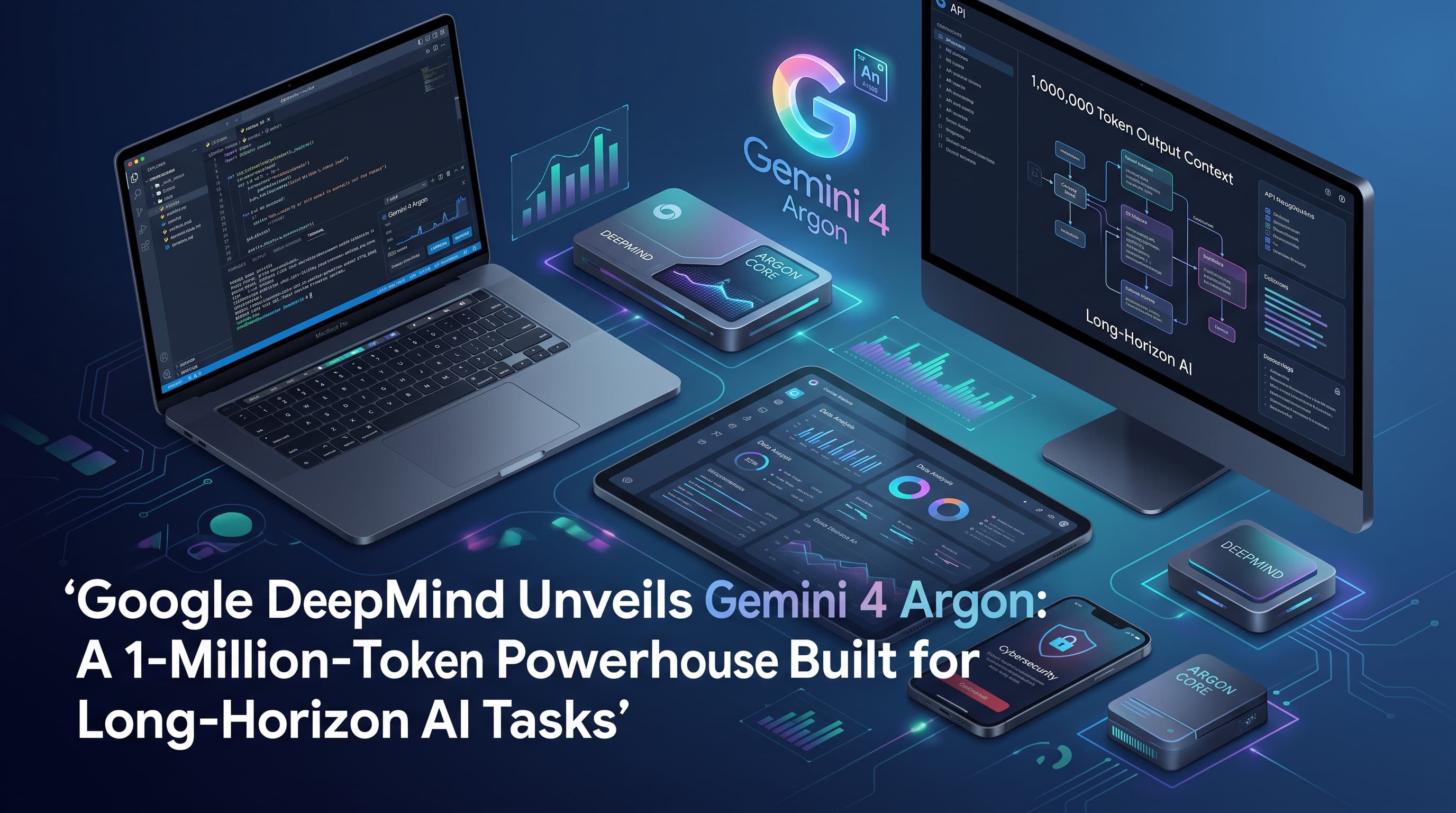
Google has officially entered a new chapter of frontier AI. On October 13, 2026, the company released Gemini 4 Argon — its most capable reasoning model to date — and the numbers behind it are hard to ignore. With an industry-first 1-million-token output limit and a #1 ranking on the Vals Index, this model is built for the kind of long-horizon, high-stakes work that previous generations of AI could only approximate.
What Makes Gemini 4 Argon Different
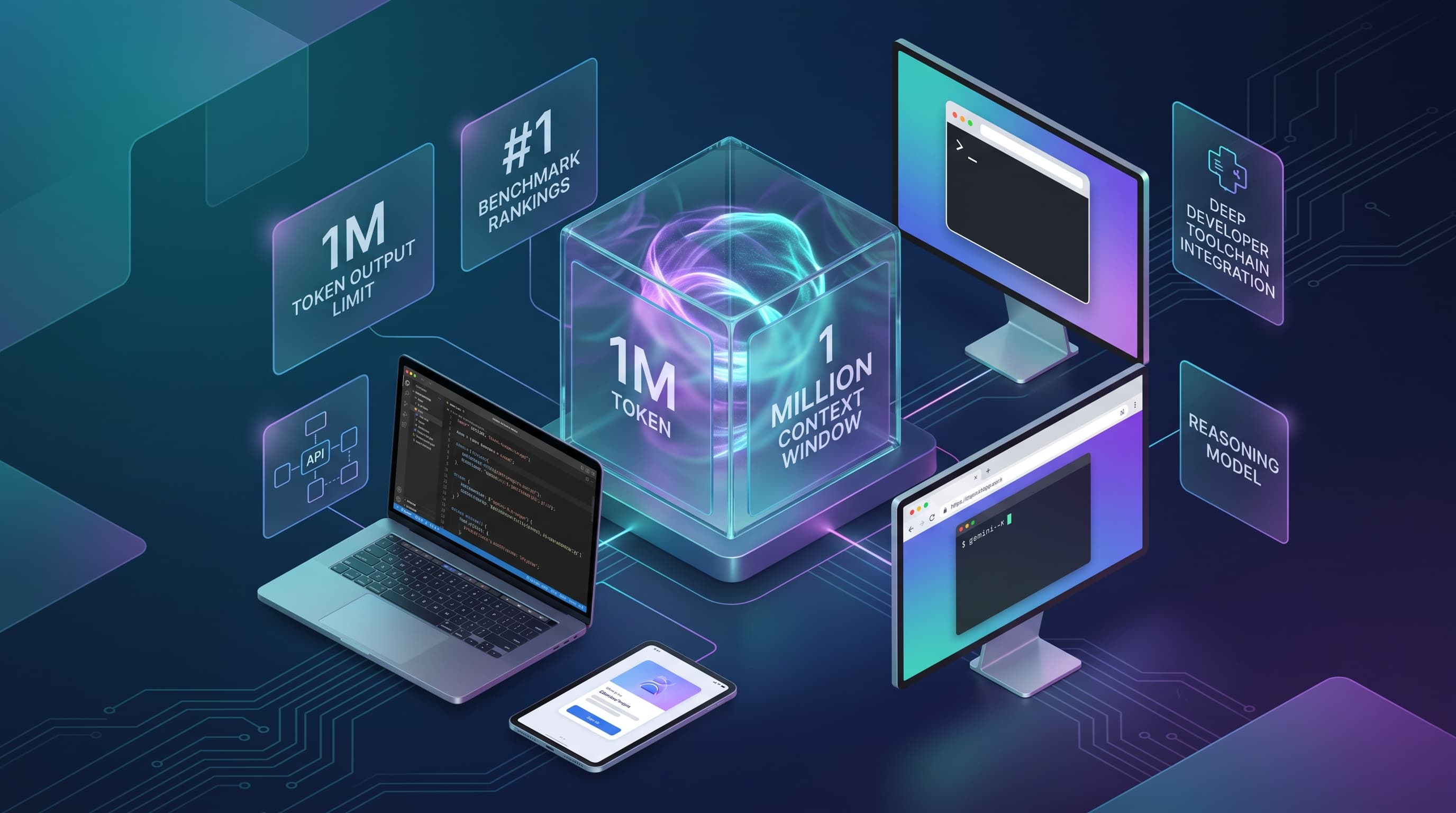
Most frontier models have pushed the boundaries of input context windows. Gemini 4 Argon flips the equation by dramatically expanding output capacity. The model supports up to 1 million output tokens — an industry first — enabling it to generate entire applications, synthesize complex datasets, and execute multi-step agentic workflows in a single pass.
This isn't just a spec bump. A 1-million-token output ceiling fundamentally changes what's possible in autonomous software engineering, financial modeling, and scientific research pipelines. Tasks that previously required chaining multiple model calls can now be completed end-to-end in one request.
Vals Index: #1 Across Economic Domains
Gemini 4 Argon currently ranks #1 on the Vals Index, a benchmark that evaluates AI performance across high-value economic domains including finance, coding, legal work, and tax analysis. According to Google's official announcement, this positions Argon as the leading model for professional and enterprise use cases where accuracy and reasoning depth are non-negotiable.
Training Infrastructure
Gemini 4 Argon was trained on Google's own Tensor Processing Unit (TPU) hardware using the JAX and ML Pathways software frameworks — the same stack that underpins Google's most ambitious ML research. This tight hardware-software co-design is a key reason the model achieves the scale it does.
Where You Can Access It
Developers can start building with Gemini 4 Argon today. The model is available across Google's primary AI development surfaces under the API model ID gemini-4-argon.
Google AI Studio: The fastest way to prototype — access Argon directly in the browser-based IDE with no infrastructure setup required.
Gemini Platform: Full API access for production integrations, with support for streaming, function calling, and grounding.
Google Antigravity: Google's internal developer platform, where Argon is already deployed at scale across more than 100,000 Alphabet engineers.
Pro Tip: When calling the API, use the exact model ID
gemini-4-argonto target this specific release and avoid being routed to an older model version.
Real-World Impact: Inside Google Antigravity
The most compelling evidence for Gemini 4 Argon's capabilities comes from inside Google itself. According to the Google Antigravity Blog, more than 100,000 internal Alphabet developers are already using the model in their daily workflows — and the results are measurable.
35% increase in agentic code: Developers are delegating more complex, multi-step coding tasks to the model, with Argon completing them autonomously end-to-end.
30% reduction in post-submit rollbacks: Code quality has improved significantly, meaning fewer bugs and regressions make it through to production.
These aren't cherry-picked demos — they reflect the model's performance at production scale, across one of the most demanding engineering organizations in the world.
Pricing: What It Costs to Build With Argon
Google is offering introductory API pricing through November 30, 2026. The rates are competitive for a frontier reasoning model at this capability level.
Input tokens: $2 per million tokens — straightforward and predictable for most workloads.
Output tokens: $10 per million tokens — higher, but expected given the model's extended generation capabilities.
Cached inputs: Discounted by 95% — a significant cost lever for applications that repeatedly reference the same context, such as large codebases or document corpora.
Important: The 95% cache discount makes Gemini 4 Argon particularly cost-efficient for retrieval-augmented generation (RAG) pipelines and long-running agentic sessions where system prompts or reference documents are reused across many calls.
Key Takeaways
Industry-first output scale: The 1-million-token output limit enables full autonomous application generation and complex synthesis in a single API call.
Top benchmark performance: Gemini 4 Argon holds the #1 position on the Vals Index across finance, coding, legal, and tax domains.
Proven at scale: Internal Alphabet deployment shows a 35% rise in agentic code and a 30% drop in production rollbacks across 100,000+ developers.
Accessible across Google's stack: Available now in AI Studio, the Gemini Platform, and Google Antigravity under the model ID
gemini-4-argon.Cost-effective caching: A 95% discount on cached inputs makes it practical to build high-context, long-running applications without runaway costs.