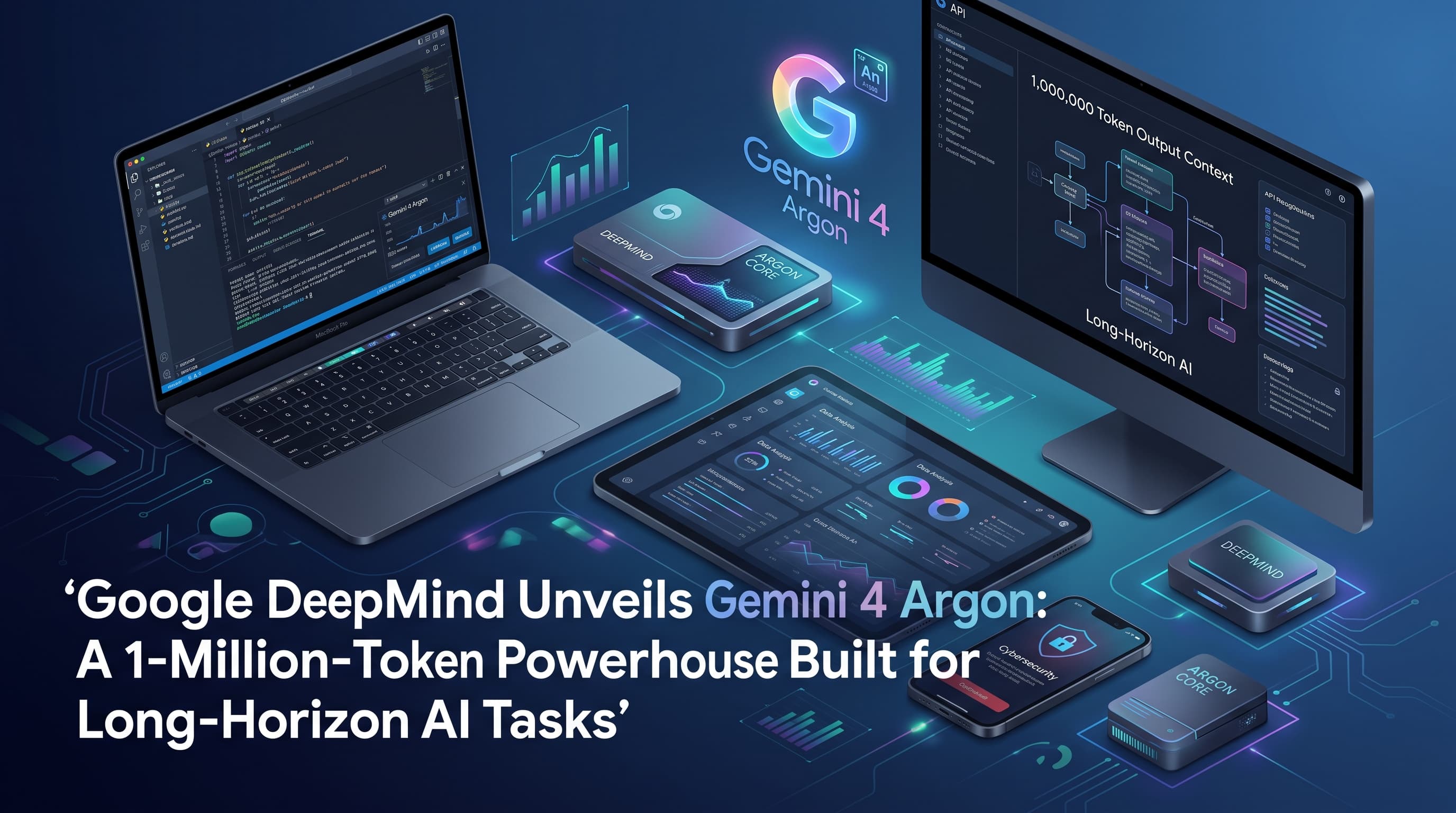
Google DeepMind officially launched Gemini 4 Argon on September 30, 2026 — the first model in its next-generation Gemini 4 series — and it arrives with specs that immediately reframe what frontier AI models are capable of. Designed for complex, long-horizon tasks like software engineering, legal analysis, and cybersecurity, Gemini 4 Argon isn't just an incremental update. It's a structural leap. Here's everything developers and AI practitioners need to know.
The Headline Feature: 1-Million-Token Output
The single most disruptive number in the Gemini 4 Argon announcement is its 1-million-token output limit — a 15x increase over the 64,000-token ceiling of previous Gemini models. For context, that's enough capacity to generate an entire software codebase, a comprehensive legal brief, or a multi-stage security audit report in a single uninterrupted run.
This isn't just a raw capacity upgrade. It fundamentally changes how developers can architect AI-powered workflows. Tasks that previously required chaining multiple model calls, managing state between requests, and stitching outputs together can now be handled end-to-end in one pass. Google's official announcement frames this as enabling "deep, multi-step reasoning in a single run" — a capability that directly targets agentic use cases.
Benchmark Performance: Back at the Top
Google is making a clear competitive statement with Gemini 4 Argon's benchmark results. Across both software engineering and legal reasoning evaluations, the model claims the top spot over rivals from Anthropic and OpenAI.
Software Engineering
On the DeepSWE v1.1 coding benchmark, Gemini 4 Argon scored 77.9% — outpacing Claude Opus 5.5 at 74.2% and GPT-6 Astra at 74.1%. VentureBeat's analysis notes this result puts Google back in the benchmark lead after a period of intense competition.
Legal Reasoning
On Harvey's Legal Agent Benchmark, Gemini 4 Argon scored 19.6% — a striking gap over GPT-6 Astra's 5.4%. While absolute scores on legal benchmarks remain low across the industry (reflecting the genuine difficulty of the task), the relative margin here is significant and positions the model as a serious tool for legal tech applications.
Important: Benchmark scores are useful signals but not guarantees of real-world performance. Teams building production legal or security tools should conduct their own domain-specific evaluations before deploying any AI model.
What Google Is Already Using It For
Google isn't just shipping Gemini 4 Argon to external customers — the company is already deploying it internally at scale, and the use cases reveal exactly what the model is optimized for.
C/C++ to Rust migration: Google is using Gemini 4 Argon to port legacy codebases — including the Fuchsia Zircon kernel and the libgav1 video decoder — to Rust, a language prized for memory safety.
Data center memory optimization: Internal deployments have already freed up over 300 TiB of memory across Google's infrastructure by using the model to identify and resolve inefficiencies.
Cybersecurity analysis: The model's initial external rollout is specifically targeting security professionals, underscoring its strength in threat analysis and long-context reasoning over complex system logs and codebases.
Access, Pricing, and Rollout
Gemini 4 Argon's launch is deliberately staged. Google is not doing a wide open release — access is being gated by use case and risk profile, starting with the highest-stakes domain first.
Phase 1 — Fairwind Program: Initial access is restricted to trusted cyber defenders enrolled in Google's Fairwind Program, a vetted group of security professionals.
Phase 2 — Paid API & Ultra subscribers: Broader access for paid API customers and Google AI Ultra subscribers is scheduled to follow, though specific dates have not been confirmed.
API pricing: Introductory pricing is set at $2 per million input tokens and $10 per million output tokens, with cached input tokens discounted by 95% — a significant cost lever for applications that reuse large context windows repeatedly.
Pro Tip: If your application involves repeated queries against a large, stable context — such as a fixed codebase or legal corpus — the 95% discount on cached input tokens could dramatically reduce your API costs at scale.
Key Takeaways
1-million-token output is the defining feature: This enables true long-horizon agentic tasks without multi-call orchestration overhead.
Benchmark leadership is real but narrow: Gemini 4 Argon leads on DeepSWE v1.1 (77.9%) and Harvey's Legal Benchmark (19.6%), but margins over Claude Opus 5.5 and GPT-6 Astra are measured in single digits on coding tasks.
Rollout is intentionally restricted: Cybersecurity professionals in the Fairwind Program get first access; broader API availability follows later.
Google is dogfooding aggressively: Internal use cases — Rust migration, 300+ TiB memory recovery — validate the model's capability on real engineering problems at massive scale.
Pricing rewards context reuse: At $2 input / $10 output per million tokens with 95% cache discounts, cost-conscious teams should architect for maximum context reuse from day one.