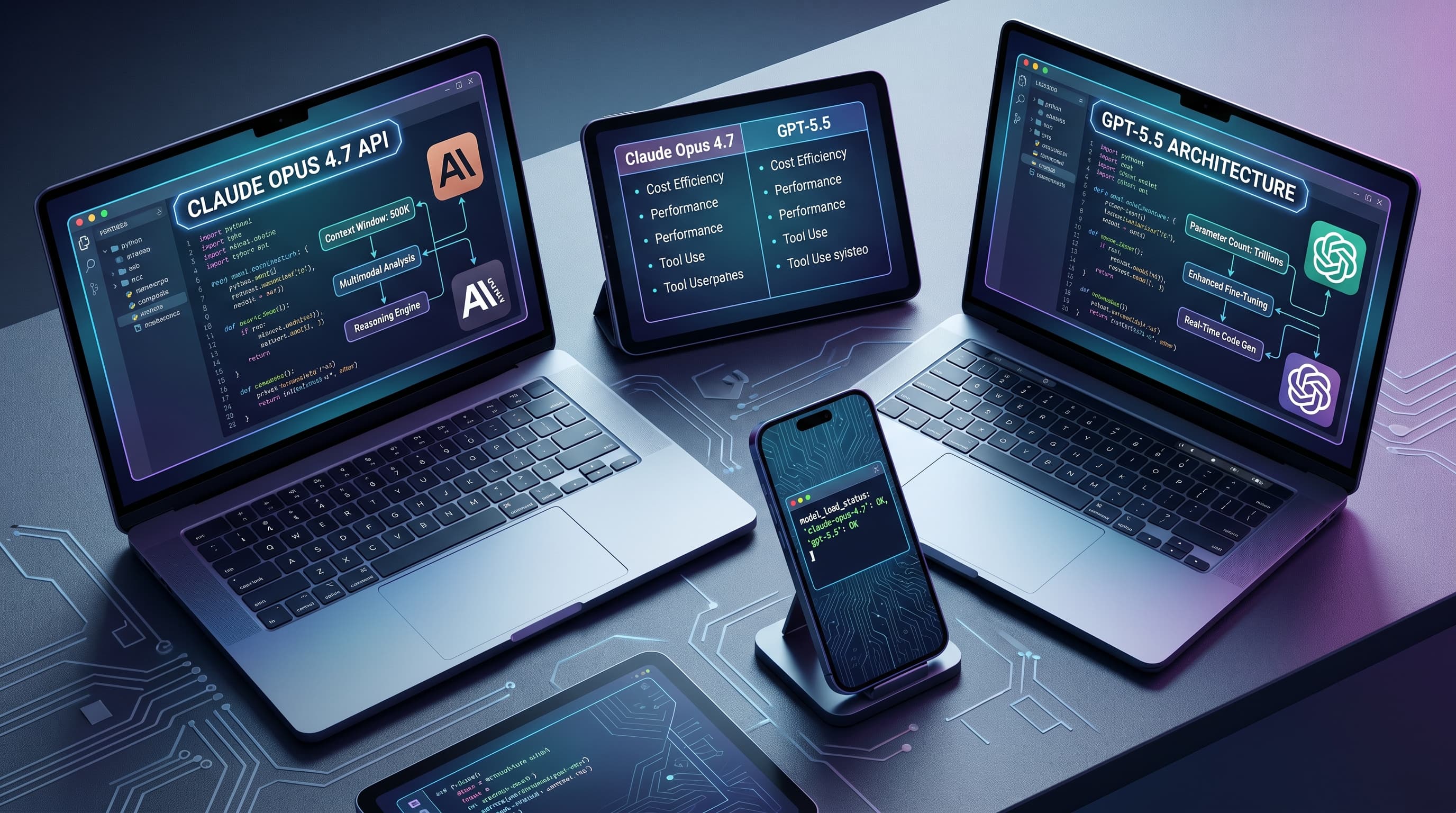
The AI arms race just leveled up — again. Anthropic and OpenAI have both released significant model updates within the same cycle, giving developers two powerful new options to evaluate: Claude Opus 4.7 and GPT-5.5. Whether you're building production applications, fine-tuning pipelines, or just keeping pace with the field, here's what matters.
What's New With Claude Opus 4.7
Anthropic's Claude Opus 4.7 builds on the Opus 4 foundation with targeted improvements to reasoning depth, instruction-following precision, and long-context performance. It sits at the top of Anthropic's model tier, designed for complex, multi-step tasks that demand both accuracy and nuance.
The update continues Anthropic's focus on Constitutional AI principles — meaning Opus 4.7 is tuned to be more resistant to jailbreaks, more transparent about its limitations, and more consistent across long conversations.
Key Improvements in Opus 4.7
Extended context handling: Improved coherence and retrieval accuracy across very long documents, making it stronger for RAG pipelines and document analysis workflows.
Instruction fidelity: Better adherence to complex, multi-part system prompts - a critical upgrade for enterprise deployments with strict behavioral requirements.
Reduced hallucination rate: Anthropic reports measurable gains in factual grounding, particularly in technical and scientific domains.
Tool use refinements: More reliable function calling and agentic task execution, closing the gap with OpenAI's tool-use ecosystem.
Pro Tip: If your application relies heavily on system prompt compliance or handles sensitive regulated content, Opus 4.7's Constitutional AI tuning gives it a structural safety advantage worth evaluating in your test suite.
What's New With GPT-5.5
OpenAI's GPT-5.5 is best understood as a significant mid-cycle refinement rather than a ground-up rebuild. It sharpens the capabilities introduced in GPT-5, with notable gains in multimodal reasoning, code generation, and real-time tool orchestration.
GPT-5.5 also brings efficiency improvements - OpenAI has reduced latency at high token counts, making it more viable for real-time applications that previously had to trade down to GPT-4o for speed.
Key Improvements in GPT-5.5
Multimodal reasoning: Stronger image-plus-text reasoning chains, with better performance on tasks that require synthesizing visual context alongside complex instructions.
Code generation accuracy: Measurable improvements on HumanEval and SWE-bench style benchmarks, particularly for multi-file refactoring and debugging tasks.
Reduced latency at scale: OpenAI has optimized inference efficiency, making GPT-5.5 faster than its predecessor at equivalent token loads.
Improved tool orchestration: Better multi-step function calling with fewer dropped steps in complex agentic chains.
Structured output reliability: More consistent JSON schema adherence, reducing the need for output validation layers in production pipelines.
Important: GPT-5.5 pricing has not been confirmed at the time of publication. Factor potential cost changes into your architecture decisions before committing to a migration from GPT-4o or GPT-5.
Head-to-Head: Which Model Fits Your Use Case
Both models are genuinely capable - but they have different strengths that map to different workloads. Choosing between them isn't about which is "better" in the abstract; it's about which aligns with your specific requirements.
Choose Claude Opus 4.7 If You Need:
Strict compliance behavior: Regulated industries like healthcare, legal, and finance benefit from Opus 4.7's more predictable refusal patterns and transparent reasoning.
Long-document workflows: Summarization, contract review, and research synthesis tasks where coherence across 100k+ tokens is non-negotiable.
Complex prompt architectures: Applications with layered system prompts, personas, or multi-role instructions where instruction fidelity is critical.
Choose GPT-5.5 If You Need:
Multimodal pipelines: Applications that blend image understanding with complex text reasoning will see the clearest gains from GPT-5.5's updated vision stack.
High-velocity code generation: Developer tooling, copilots, and automated code review workflows where benchmark accuracy directly translates to user value.
Real-time agentic systems: Latency-sensitive agents that need fast, reliable tool calls at production scale.
Key Takeaways
Both models raise the bar: Claude Opus 4.7 and GPT-5.5 represent meaningful upgrades over their predecessors - not just marketing refreshes.
Safety vs. speed trade-offs persist: Anthropic continues to prioritize behavioral consistency and safety guardrails; OpenAI leans into performance and multimodal breadth.
Benchmark scores aren't enough: Run both models against your actual production prompts and edge cases before making a platform decision.
Agentic use cases are the real battleground: Both releases signal that reliable multi-step tool use is now a primary competitive dimension, not a secondary feature.
Cost modeling matters: Evaluate total cost of ownership - including token efficiency and retry rates - not just per-token pricing before switching stacks.