The browser wars are back — and this time, artificial intelligence is the battlefield. A wave of AI-native browsers is emerging to challenge the decade-long dominance of Chrome, promising to replace passive tab management with active, reasoning-powered agents that browse with you, not just for you. Here is what is coming, who is building it, and why it matters for developers, power users, and the future of the web.
Why the Browser Is AI's Next Frontier
The browser is the most-used application on any device. It is where work happens, research is done, and decisions are made. For AI companies, embedding an agent at that layer is the ultimate distribution play — a permanent seat at the table for every session a user has online.
Traditional browsers treat AI as a sidebar feature, a bolted-on chatbot living behind a keyboard shortcut. AI-native browsers flip that model entirely: the reasoning engine is the browser's core operating system, and the web renderer is just one of its tools.
Why Now?
Three forces are converging to make this moment possible. Large language models are now fast and cheap enough to run inference on every page load without noticeable latency. Browser engine development has matured to the point where new entrants can build on Chromium without starting from scratch. And user frustration with ad-bloated, privacy-eroding browsing experiences has created genuine demand for an alternative.
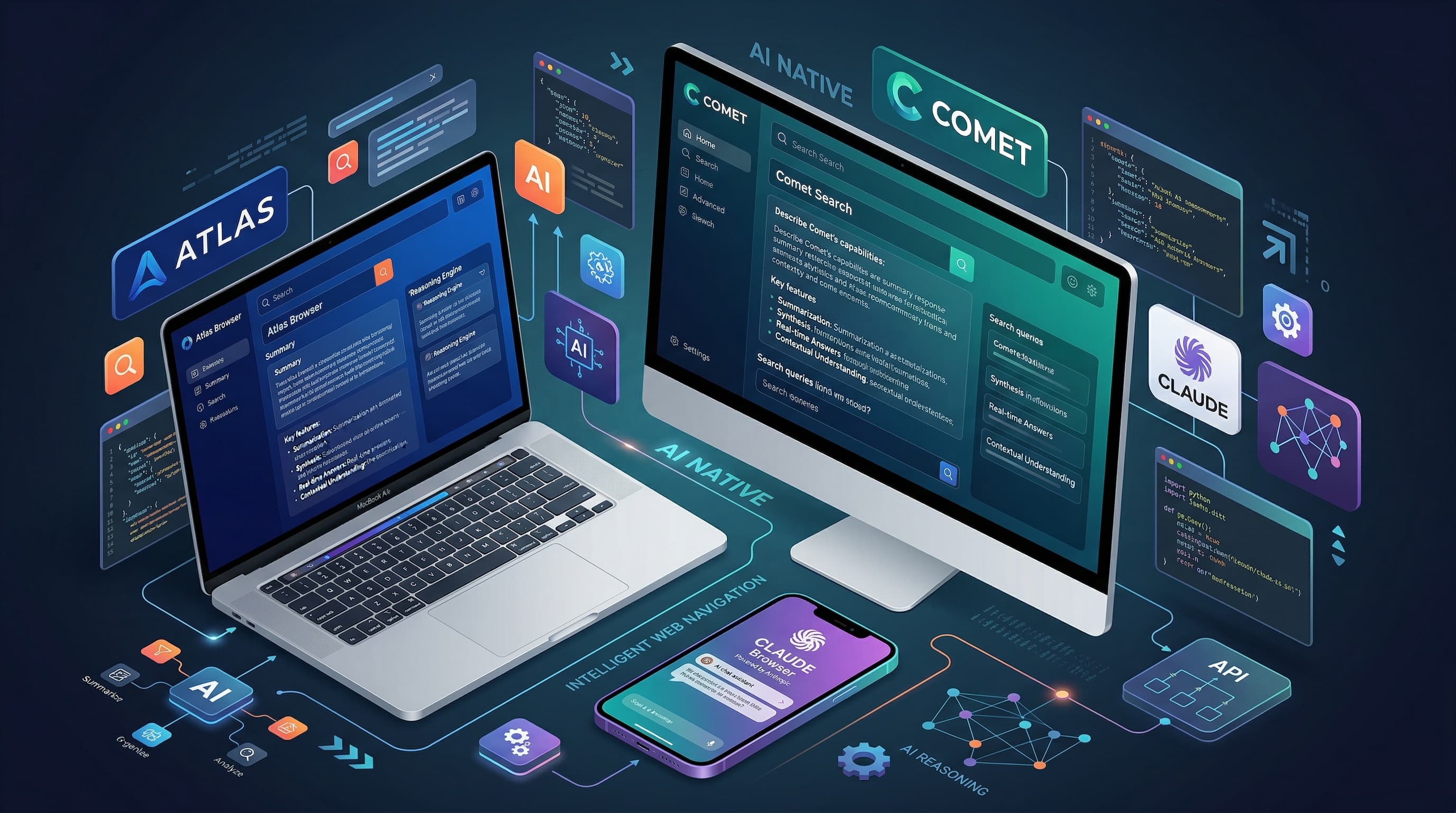
The Contenders: Atlas, Comet, and Claude Browser
Several well-funded players are racing to define what an AI browser actually looks like in practice. Each takes a meaningfully different approach.
Perplexity Comet
Perplexity — the AI search startup that has already rattled Google — is building Comet as a direct extension of its answer-engine philosophy. Rather than returning a list of blue links, Comet aims to synthesize information across tabs in real time, surfacing answers inline as you browse. The browser is expected to integrate Perplexity's deep research capabilities natively, letting users trigger multi-step research tasks without leaving the page they are on.
Key Differentiator: Comet is designed around Perplexity's existing search graph, meaning it has a head start on sourcing, citation, and real-time web data that pure LLM-based browsers will need to build from scratch.
Atlas Browser
Atlas is positioning itself as the power user's AI browser, with a focus on agentic task execution. Think filling out forms, navigating multi-step workflows, and managing complex research sessions autonomously. Atlas leans heavily into the concept of a persistent AI memory layer — the browser learns your preferences, your projects, and your recurring tasks over time.
For developers and knowledge workers, Atlas's pitch is compelling: a browser that does not just display the web but actively operates within it on your behalf, with guardrails you control.
Anthropic's Claude Browser
Anthropic has not officially launched a standalone browser, but the signals are hard to ignore. With Claude already embedded in the Arc browser via the Browser Company partnership, and Anthropic's heavy investment in its computer-use API — which lets Claude interact with on-screen interfaces — a first-party browser feels less like speculation and more like a roadmap item.
A Claude-native browser would likely prioritize safety and interpretability above raw capability, consistent with Anthropic's core research mission. Expect deep integration with Claude's extended thinking mode for complex, multi-hop reasoning tasks across web sessions.
Worth Watching: Anthropic's computer-use feature already allows Claude to control a browser programmatically. A consumer-facing product built on that foundation could leapfrog competitors in agentic capability on day one.
What AI Browsers Actually Do Differently
Marketing aside, there are concrete functional differences between an AI-native browser and Chrome with a Copilot extension pinned to the toolbar.
Inline synthesis: Instead of opening a new tab to ask a question, the browser reads the current page and adjacent context to answer queries without breaking your flow.
Agentic task execution: The browser can be instructed to complete multi-step tasks — booking a flight, comparing product specs across five sites, filling a form — autonomously and with minimal hand-holding.
Persistent memory: AI browsers maintain a session-aware and cross-session memory of your preferences, projects, and history, making each interaction smarter than the last.
Proactive suggestions: Rather than waiting to be asked, the browser surfaces relevant actions, related content, or warnings based on what it infers you are trying to accomplish.
Privacy-first architecture: Several contenders are building with on-device model inference as a differentiator, reducing the amount of browsing data sent to external servers.
The Developer and Privacy Implications
AI browsers introduce a new surface area that developers and privacy advocates are only beginning to map. If a browser's AI layer can read every page you visit, synthesize your behavior across sessions, and execute actions on your behalf, the data model is fundamentally different from anything that came before.
For Developers
Web developers will need to think about how their sites behave when an AI agent is the primary "user." Structured data, semantic HTML, and accessible markup — long recommended best practices — become critical signals for AI browsers trying to interpret page intent. Sites optimized for human eyes may perform poorly when parsed by a reasoning engine looking for actionable information.
For Privacy-Conscious Users
The same capabilities that make AI browsers powerful make them sensitive. A browser that knows your research history, your financial queries, and your health searches is an extraordinarily valuable data asset. Users should scrutinize each browser's data retention policy, on-device versus cloud inference architecture, and whether browsing data is used to train future models before committing to any platform.
Pro Tip: Before adopting any AI browser, check whether it offers a clear opt-out from training data collection and whether its AI inference runs locally or routes through external servers. These two questions will tell you most of what you need to know about its privacy posture.
Key Takeaways
AI browsers are a strategic land grab: For AI companies, owning the browser layer means owning the most valuable real estate in a user's digital life — every session, every query, every decision.
Comet, Atlas, and a potential Claude Browser each take distinct approaches: Search synthesis, agentic task execution, and safety-first reasoning represent three genuinely different product philosophies worth tracking separately.
Agentic capability is the real differentiator: The gap between AI browsers and AI-enhanced browsers is not chat — it is autonomous, multi-step task execution that works across the entire web.
Developers need to adapt: Semantic, well-structured HTML is no longer just an accessibility best practice — it is how your site communicates with the AI agents that will increasingly be your primary visitors.
Privacy scrutiny is non-negotiable: The power of these platforms is inseparable from their data risk. Users and enterprises alike should evaluate AI browsers with the same rigor they apply to any system with access to sensitive information.