OpenAI’s annual DevDay conference has officially signaled the end of the chatbot era, pivoting aggressively toward autonomous workspaces. By introducing 'Dots' and a tiered subscription strategy, the company is moving beyond simple conversational interfaces to build a persistent, task-oriented ecosystem.
For developers and enterprise users, these updates represent a fundamental change in how AI interacts with existing software stacks. This guide breaks down the most critical announcements from the event and what they mean for your development workflow.
The Rise of 'Dots'
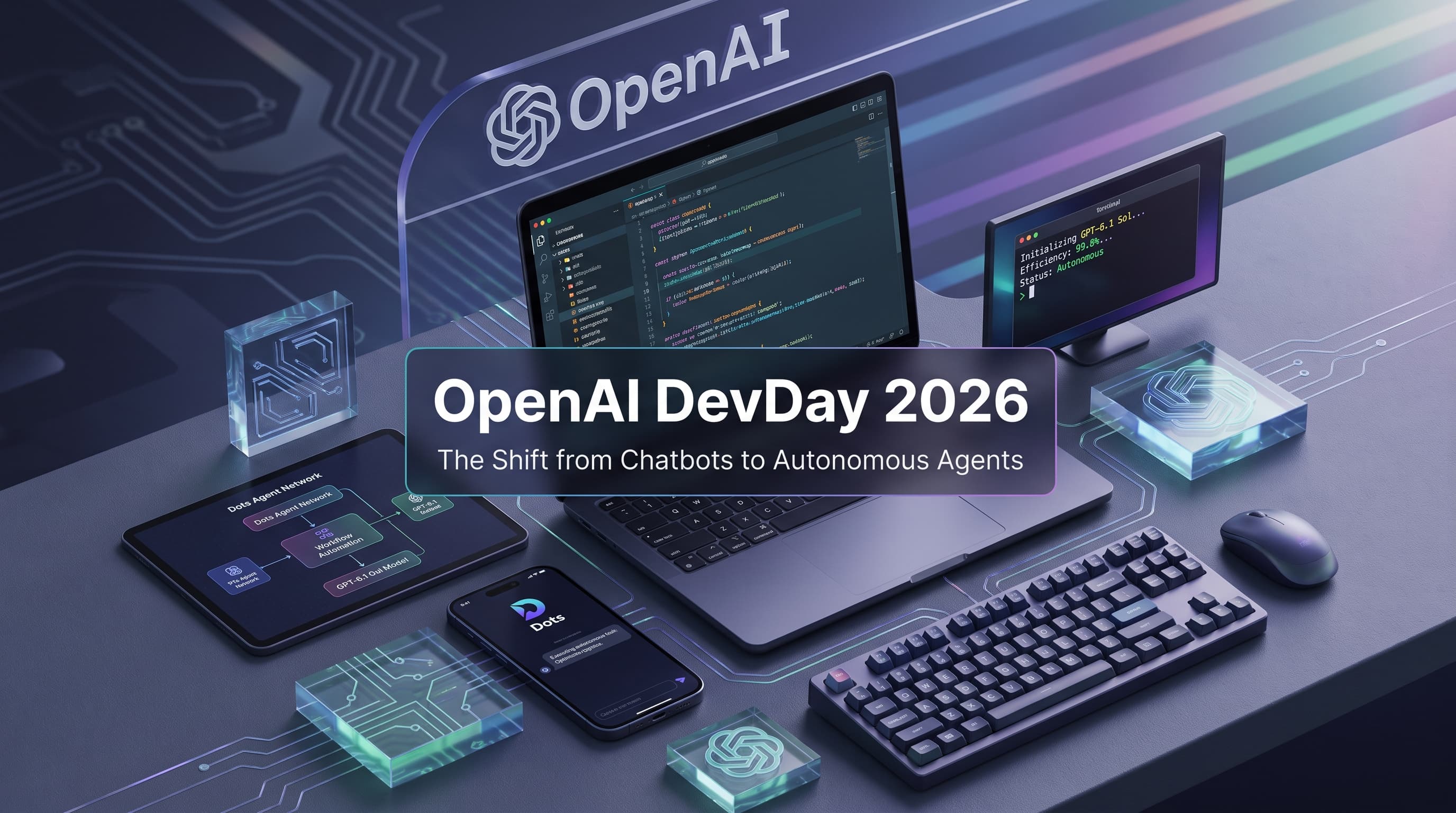
The headline announcement was the introduction of Dots, always-on personal AI agents powered by GPT-6 Astra. Unlike traditional models that wait for a prompt, these agents operate autonomously 24/7 on dedicated cloud infrastructure.
Connecting Your Ecosystem
Dots are designed to function as an extension of the user, capable of managing complex workflows across thousands of third-party applications. By integrating with over 4,000 services—including Slack and Microsoft Teams—these agents can execute tasks without requiring constant human oversight.
Important: Ensure your team reviews the security permissions for Dots within your enterprise environment, as these agents operate with significant autonomy across your connected apps.
Model Efficiency and Performance
OpenAI also unveiled GPT-6.1 Sol, a near-frontier model optimized for high-intensity professional tasks like complex coding and computer use. Crucially, it achieves this performance at a fraction of the cost, priced at $2 per million input tokens and $10 per million output tokens.
Cost-effective scaling: GPT-6.1 Sol provides near-Astra intelligence at one-fifth the cost of standard API pricing.
Low-latency decisioning: The new Decisions API, powered by GPT-6 Luna, offers sub-200ms response times for classification and routing tasks.
Collaborative hubs: The newly launched 'ChatGPT Spaces' allows humans, AI, and Dots to share information and organize files in a centralized environment.
New Tiered Subscription Strategy
Alongside the technical releases, OpenAI updated its subscription model to cater to power users and enterprises. The new 'Pro 500' tier, priced at $500 per month, grants access to 'Ultrafast' processing speeds for GPT-6 Astra.
However, the shift also impacts existing users. According to official documentation, the 'Pro 200' plan has seen its compute allowance halved, with message caps reduced to 100 per week to prioritize the newer, higher-tier infrastructure.
Key Takeaways
Autonomous Agents: 'Dots' represent a shift toward 24/7, agent-driven workflows that can manage tasks across 4,000+ integrated apps.
Model Optimization: GPT-6.1 Sol delivers high-end intelligence for coding and professional tasks at a significantly lower price point than previous iterations.
Infrastructure Costs: The introduction of the 'Pro 500' tier and the reduction of allowances on the 'Pro 200' plan signal a push toward incentivizing higher-tier enterprise adoption.
Real-time API: The Decisions API offers a new, high-speed interface for developers needing rapid, single-decision logic in their applications.