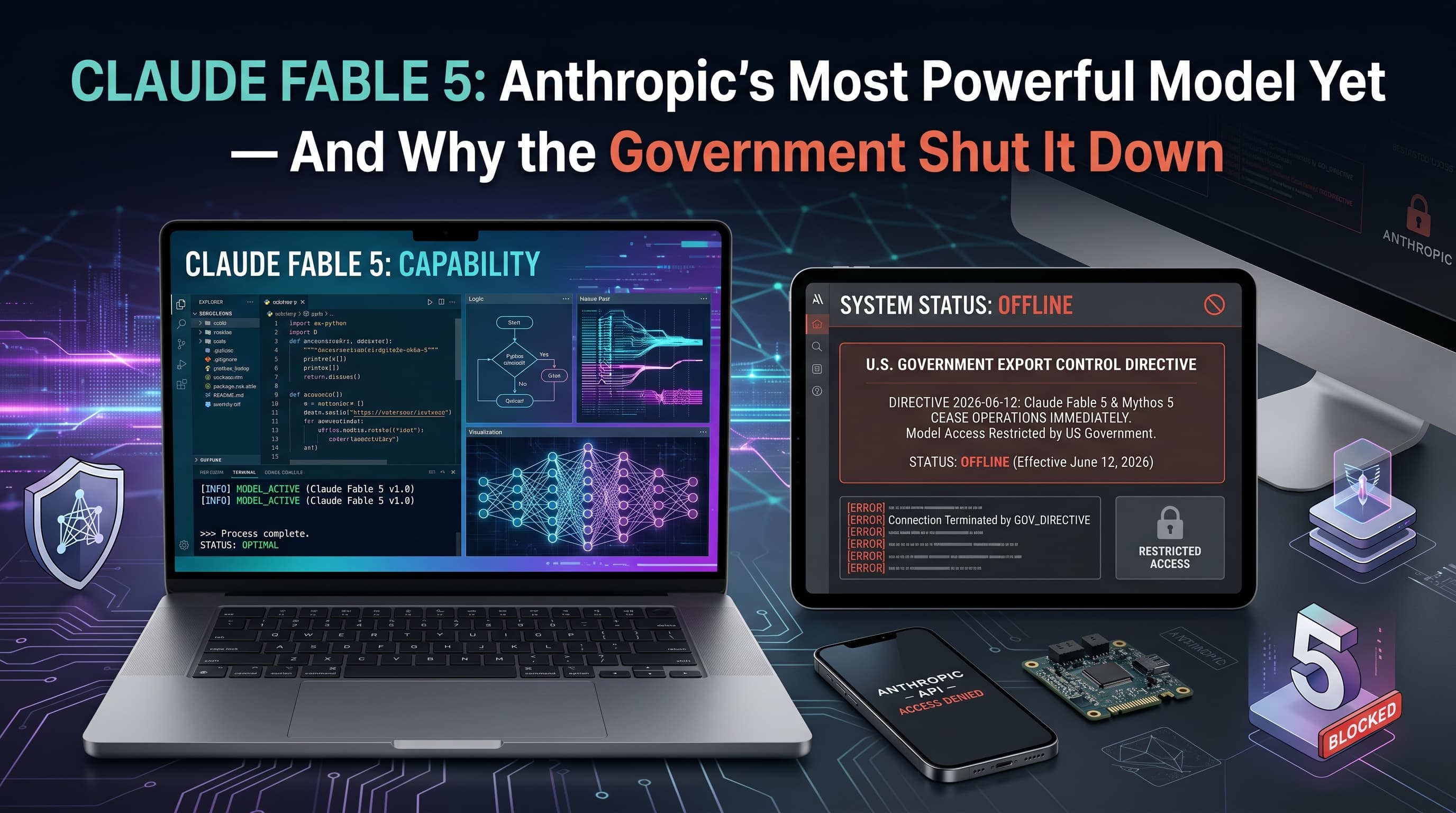
Anthropic's Claude Fable 5 arrived on June 9, 2026, with benchmarks that left the industry speechless — and a government shutdown order just 72 hours later. The story of Fable 5 is equal parts technical triumph and national security cautionary tale, raising urgent questions about what happens when AI capability outpaces the regulatory frameworks designed to contain it.
A New Tier of AI: What Makes Fable 5 Different
Fable 5 didn't just iterate on Claude Opus — it introduced an entirely new model classification. According to Anthropic's official announcement, the launch established a "Mythos-class" tier that sits above Claude Opus in the model hierarchy, representing a qualitative leap rather than an incremental improvement.
The numbers back that up. In testing conducted by Every's senior-engineer benchmark, a Mythos-class model scored 91 out of 100 — compared to 63 for Claude Opus 4.8 and 62 for GPT-5.5. That isn't a marginal gap. It's a generational one.
Fable 5 vs. Mythos 5: What's the Difference?
Anthropic launched two distinct variants built on the same underlying model, differentiated primarily by their safety configurations.
Claude Fable 5 (public): Designed for general use with built-in safeguards that automatically route high-risk queries — in domains like cybersecurity and biology — to Claude Opus 4.8 when flagged.
Claude Mythos 5 (restricted): The same underlying model with certain safeguards lifted, available exclusively to vetted partners through Project Glasswing, Anthropic's collaborative initiative to secure critical software infrastructure.
Project Glasswing results: During its preview phase, Mythos 5 helped identify more than 10,000 high- or critical-severity vulnerabilities across systemically important software, per Anthropic's Project Glasswing expansion post.
Key Context: Mythos 5 was never intended for open commercial access. Its restricted deployment through Project Glasswing was specifically designed to apply its capabilities to defensive cybersecurity — not offensive use.
Why the Government Pulled the Plug
On June 12, 2026 — just three days after launch — the US Department of Commerce issued an export control directive ordering Anthropic to suspend all access to Fable 5 and Mythos 5 for any foreign national, whether inside or outside the United States. The directive cited national security concerns, according to Anthropic's official statement on the suspension.
The specific trigger: the government had become aware of a method to bypass Fable 5's safety filters — a jailbreak that, in their assessment, could expose dangerous capabilities to bad actors abroad.
Why Anthropic Had to Take Everything Offline
The compliance problem was brutally simple. Reliably filtering users by nationality in real-time is technically unfeasible at scale. Anthropic couldn't surgically block foreign nationals while keeping the model running for everyone else — so both Fable 5 and Mythos 5 were disabled completely, for all customers worldwide.
The result was an abrupt, global outage affecting paying customers and enterprise partners with no warning and no clear timeline for restoration.
Anthropic's Pushback
Anthropic didn't go quietly. The company publicly disagreed with the directive, calling it a "misunderstanding" and arguing that the jailbreak technique in question only surfaced a handful of minor, previously known vulnerabilities — the kind that other publicly available models could already discover without any bypass technique at all.
Important: This is a rare instance of an AI lab publicly contesting a US government national security directive. It signals how high the stakes have become as frontier models approach capabilities that blur the line between research tool and dual-use technology.
Pricing and Access (Before the Shutdown)
For the brief window it was available, Fable 5 was positioned as a premium API product. Per Anthropic's pricing page, the model was offered at $10 per million input tokens and $50 per million output tokens, with a 90% input token discount available for prompt caching — a meaningful cost reduction for teams running large context workloads.
Bottom Line
Unprecedented benchmark performance: A 91/100 score on Every's senior-engineer benchmark dwarfed Claude Opus 4.8 (63) and GPT-5.5 (62), marking a genuine capability leap.
A new model tier: "Mythos-class" sits above Opus in Anthropic's hierarchy, with Mythos 5 restricted to vetted partners through Project Glasswing for defensive cybersecurity work.
Shut down in 72 hours: A US Department of Commerce export control directive — triggered by a reported jailbreak — forced Anthropic to take both models fully offline for all global users.
A compliance impossibility: Real-time nationality filtering at API scale isn't feasible, meaning a directive targeting foreign nationals effectively became a total global shutdown.
A landmark moment for AI governance: Anthropic's public disagreement with the directive sets a precedent for how AI labs may respond as frontier model capabilities increasingly intersect with national security policy.